If you went tool-shopping last week, you saw the same widget on every product page. A floating bubble. A canned greeting. A model trained on a help doc nobody updated since launch. The vendor calls it a Chatbot. Capital C. Bolt-on.
We don't ship that. Not at any tier.
What we ship instead is a chat surface that closes loops — it answers what it can answer, escalates when escalating is the right move, and never strands a visitor on a "thanks for your message, someone will get back to you" placeholder. Your client base too important to be handing clientele to your competitors. The dial that separates plans isn't whether you get a chatbot. It's how much of your business is allowed to flow through it.
What every plan gets
The Launch chatbot is not a stripped demo. It's the same engine that runs on every site we host:
- A real model on every reply.
Not regex. Not a keyword tree. The bot reads your knowledge base, the visitor's prior turns, and the system prompt your team set, and writes a fresh answer each time. It knows when it doesn't know.
- Tunable end-to-end, not "configurable" in marketing-speak.
Pick the model — Claude Haiku for fast, Claude Sonnet for nuance, GPT-4o family if you prefer it — and dial the temperature for how chatty or deterministic you want it. Write the system prompt. Paste in the knowledge base as an XML sitemap <loc> + <desc>) so the bot reads what you actually want it citing. Move the live-handoff slider from Never to Always. Every one of those is in the dashboard, not behind a sales call.
- Form-aware out of the box.
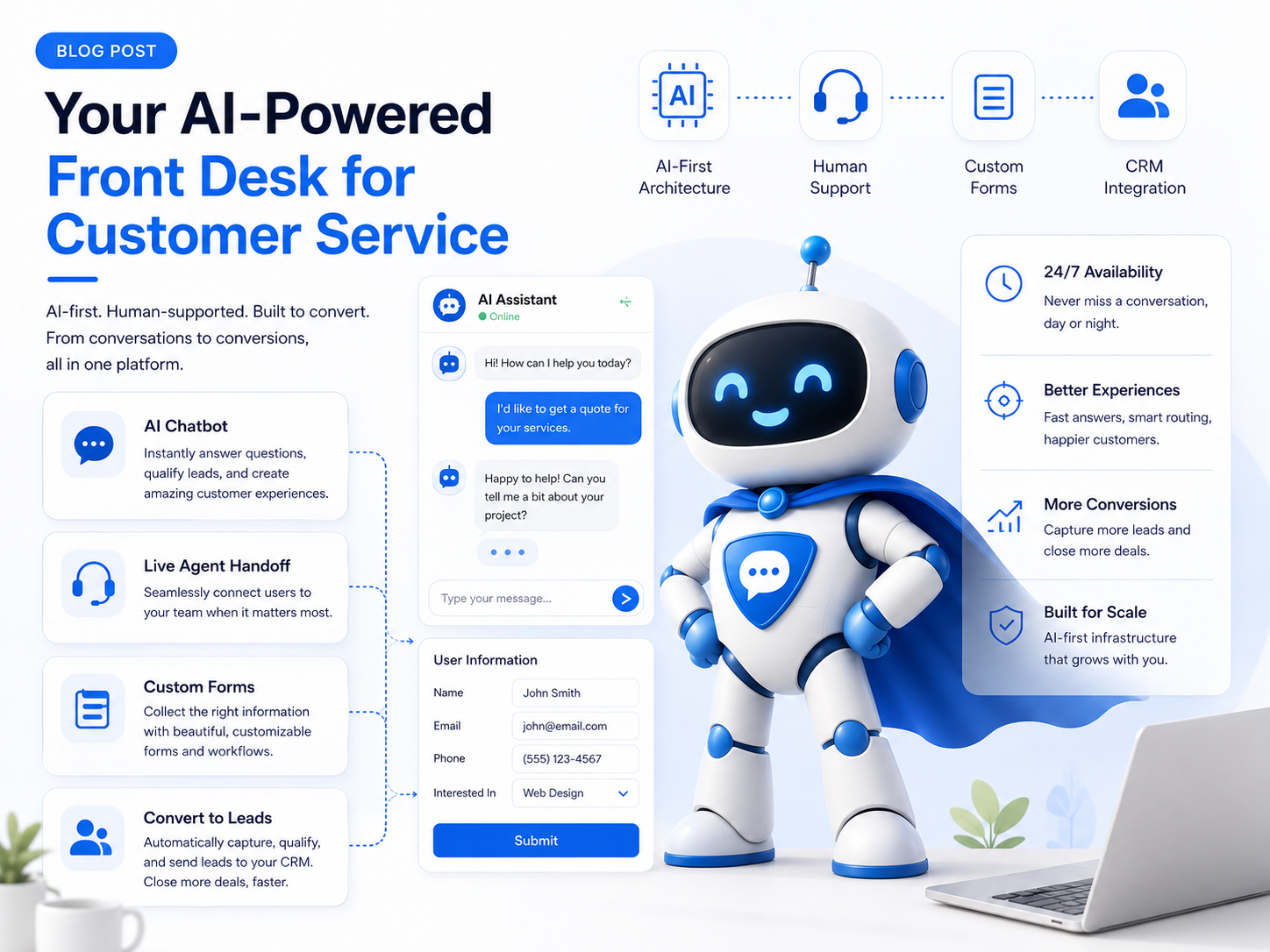
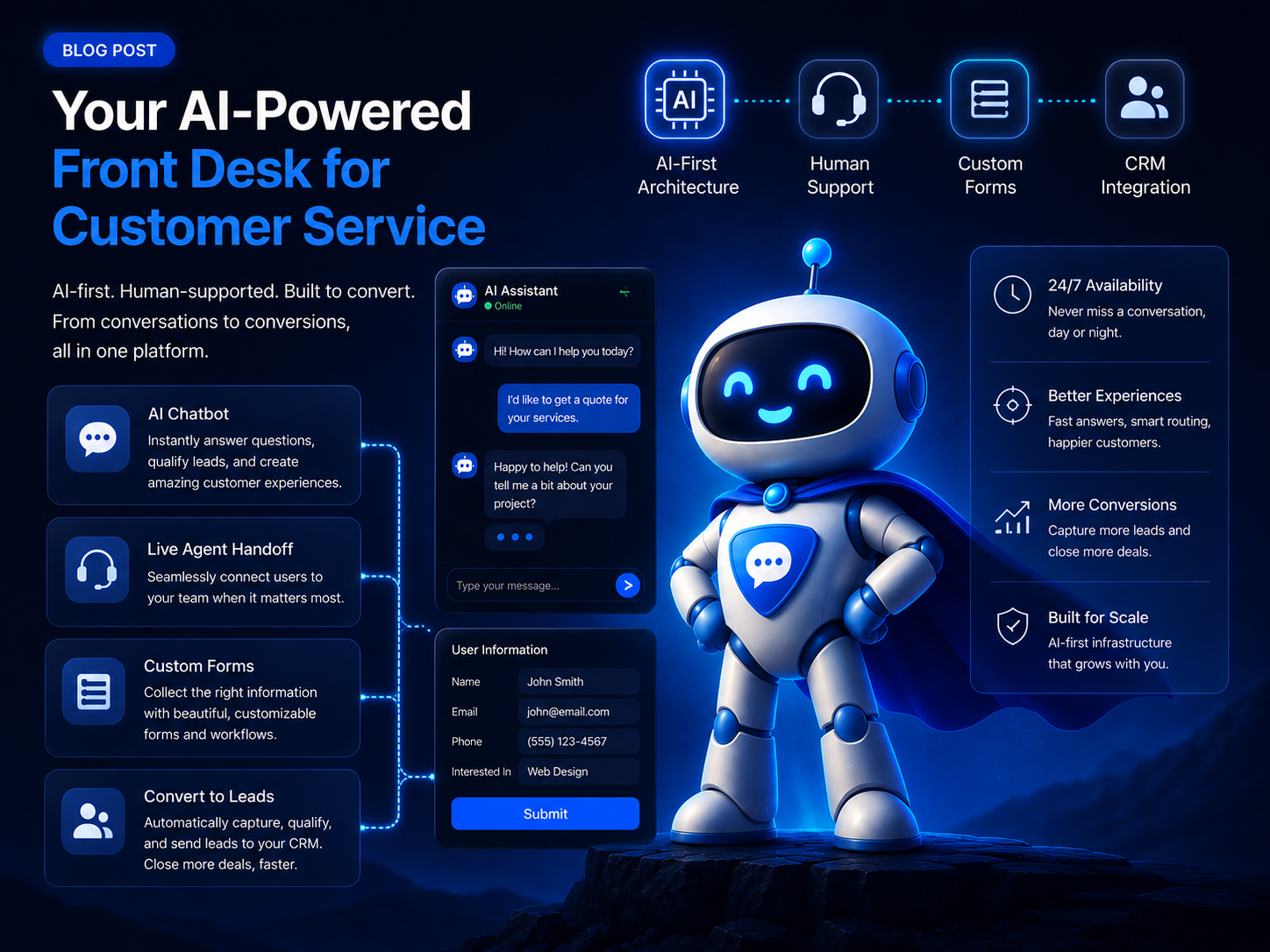
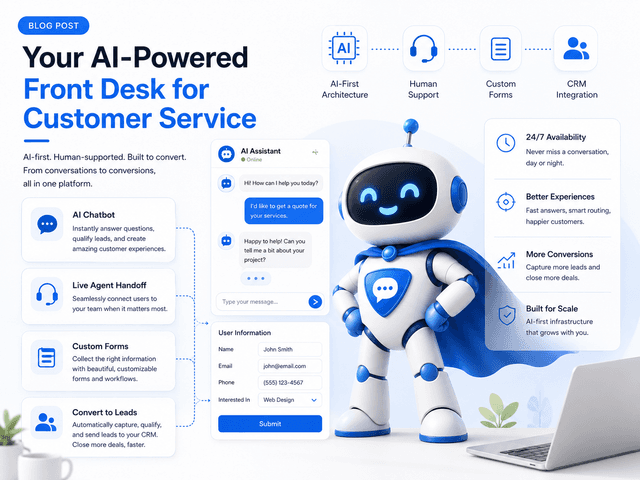
The bot already knows which forms you've published — slugs, names, descriptions, fields. When a visitor's request crosses from *"can you tell me?"* to "can you do this for me?", it surfaces the right form inline. It also knows where the resulting lead goes: a form flagged adds inquiry lands in CRM with the chat transcript attached, a form flagged adds lead lands in your leads table, and the workspace notification fires to the people set up to receive it. You wire the form once; the bot wires the rest.
- Up to three chatbot-accessible forms.
When a question crosses the line from "can you tell me?" to "can you do this for me?"— quote requests, project intake, support tickets — the bot surfaces the matching form inline. The visitor never has to navigate to a contact page they don't trust.
- Form submissions that don't disappear.
Anything submitted through chat lands in the same inbox as your contact form: User Messages, plus an inquiry in CRM if the form is set to add inquiries, plus a contact in your People table. The chat transcript that led up to the submit travels with the inquiry — your team sees the why, not just the what.
That's the bar. If a vendor charges you separately for any of the above, they're
selling you a basic chatbot dressed up.
Chatbot is dropping the mic on at Growth plan
Growth turns the bubble into a full customer support & sales desk.
- Front Desk is real.
When a visitor pressesTalk to a person, they enter a queue your team actually staffs. Anyone with the chat.handle permission sees a red badge in the navbar with the count of waiting visitors. They can peek the conversation read-only before claiming, call dibs, type back, transfer to a teammate, or ping someone in for a second pair of eyes — all from the side panel that auto-hides for everyone else.
- The visitor sees who's there.
The widget header shows up to three avatars of teammates currently online, plus an honest wait estimate that comes from your own data — not a generic "we'll respond in 24 hours". When nobody's online, the bot quietly drops theTalk to a person button and the leave-a-message flow takes over. No dead ends. No lost leads.
- A peek that's auditable.
Whoever opens a queued chat to read it gets logged. Whoever claims it gets logged. Whoever transfers it gets logged. Everything lands in the inquiry's history so a manager can answer"who saw this customer first?" in one click.
- Continuity through the funnel.
When the visitor becomes a lead, the chat record (bot + human) follows them. The staff member who claimed the live chat is recorded as the durable owner of that contact, distinct from a free-text salesperson field that gets overwritten by whoever updates last.
- Unlimited chatbot-accessible forms.
Three forms are enough for a focused launch. Once you have a quote intake, a support form, an investment & partnership form, a returns form, a recruiting form, and four product-specific lead capture variants, you are no longer limited to picking and choosing.
- A handoff dial.
We get it, You may not be capable of handling so many calls and messages, or maybe you are trying to hand off more of the convo to your age. Thus the dial: *"How willing should the bot be to suggest talking to one of your staff?"* helps you fine tune the chat with a human feature. You decide the likelihood of the bot stays out of the way to volunteers human help.
The shorthand:
Launch is a chatbot you don't have to babysit. Growth is a front desk you can choose to staff.
Why we draw the line there
Live chat is operationally expensive — not financially, operationally. The cost isn't the software, it's the human attention. A team of two with the front desk turned on but nobody watching it is worse than a team of two with no front desk at all, because now the visitor is staring at a typing indicator that nobody's typing in.
So we made the call: every plan gets a chatbot that works without your team. The plan that gets the live front desk is the plan that means you've already built a team big enough to staff it. That's why Growth is the floor, not Launch.
If you're on Launch and your team is starting to outgrow the bot's answers — visitors writing back with follow-ups, staff manually copy-pasting from chat into the CRM, the same five questions appearing in your inbox every day — that's the upgrade signal. You're not buying a feature; you're buying back the time your team is currently spending on async patchwork. You're buying back control and all the lost leads in the process.
The honest version
You'll see a lot of platforms call themselves AI-powered. Many of them are. Most of them are running a search index with a chat skin on top. The test we hold ourselves to is simple: when a real visitor asks a real question, does the platform produce *a useful next move* — answer, form, human, leave-a-message, calendar booking — or does it dead-end at "please email us"?
The research has been consistent for years, even if the exact numbers shift study to study. Most B2C buyers prefer to self-serve early in the journey — they'd rather get a clean answer from a tool than introduce themselves to a salesperson before they're ready. The end result is: **That the customer is selling themselves on your service, products or subscription before they even talk to you!** They convert at meaningfully higher rates on a contextual form filled out while their question is fresh than on a blank "send us a message" textarea they have to compose from scratch. And the response-time research is unambiguous: every minute a curious visitor waits, the conversion math gets worse.
Put those together and the design follows on its own:
The bot's job is to give a confident answer when the question has one, surface the right form when the question is really a request, and reach a real teammate when the visitor is ready for one — without making them rewrite their question into an email. Each layer is faster than the last. None of them is a wall.
We never want our your customers first point of contact to be a dead-end. That's why we don't ship a basic one. Not at the lowest tier, and definitely not at the highest.