

Your Website Shouldn’t Just Exist. It Should Work for You.
For many small and mid-sized companies, a website is treated like a digital business card.
It has the company name. A few service pages. Maybe a contact form. Maybe a gallery. Maybe an “About Us” page that has not been touched in two years.
And that may be enough to prove you exist.
But it is not enough to help you grow.
Modern businesses need more than an online presence. They need a website that can communicate, educate, attract, convert, and continue building trust long after the first visit. Your website should be one of your most valuable business assets, not something that quietly sits in the background waiting to be found.
That is exactly why we built our blog platform to be more than a place to publish updates.
It is a marketing engine. A customer education tool. A search visibility asset. A community feature. A product announcement hub. A lead generator. A credibility builder. And, when used consistently, one of the strongest ways for your business to tell its own story.
Your Business Has More to Say Than You Think
A blog is not only for media companies, influencers, or massive brands with full-time content teams.
A well-built business blog can help companies share:
Service updates
Product launches
Customer success stories
Industry insights
How-to guides
Company milestones
Case studies
Downloadable resources
Promotions
Event announcements
Hiring updates
Behind-the-scenes progress
Educational content for customers
Thought leadership from your team
For a small or mid-sized business, this matters because every post becomes another opportunity for a customer, client, partner, investor, or future employee to understand what you do and why it matters.
Instead of answering the same questions one conversation at a time, your website can answer them at scale.
Instead of relying only on ads or word of mouth, your business can build a searchable library of useful content.
Instead of letting your website go stale, you can keep it active, current, and relevant.
Built to Showcase Your Business, Not Just Store Articles
Our blog system was designed to feel alive.
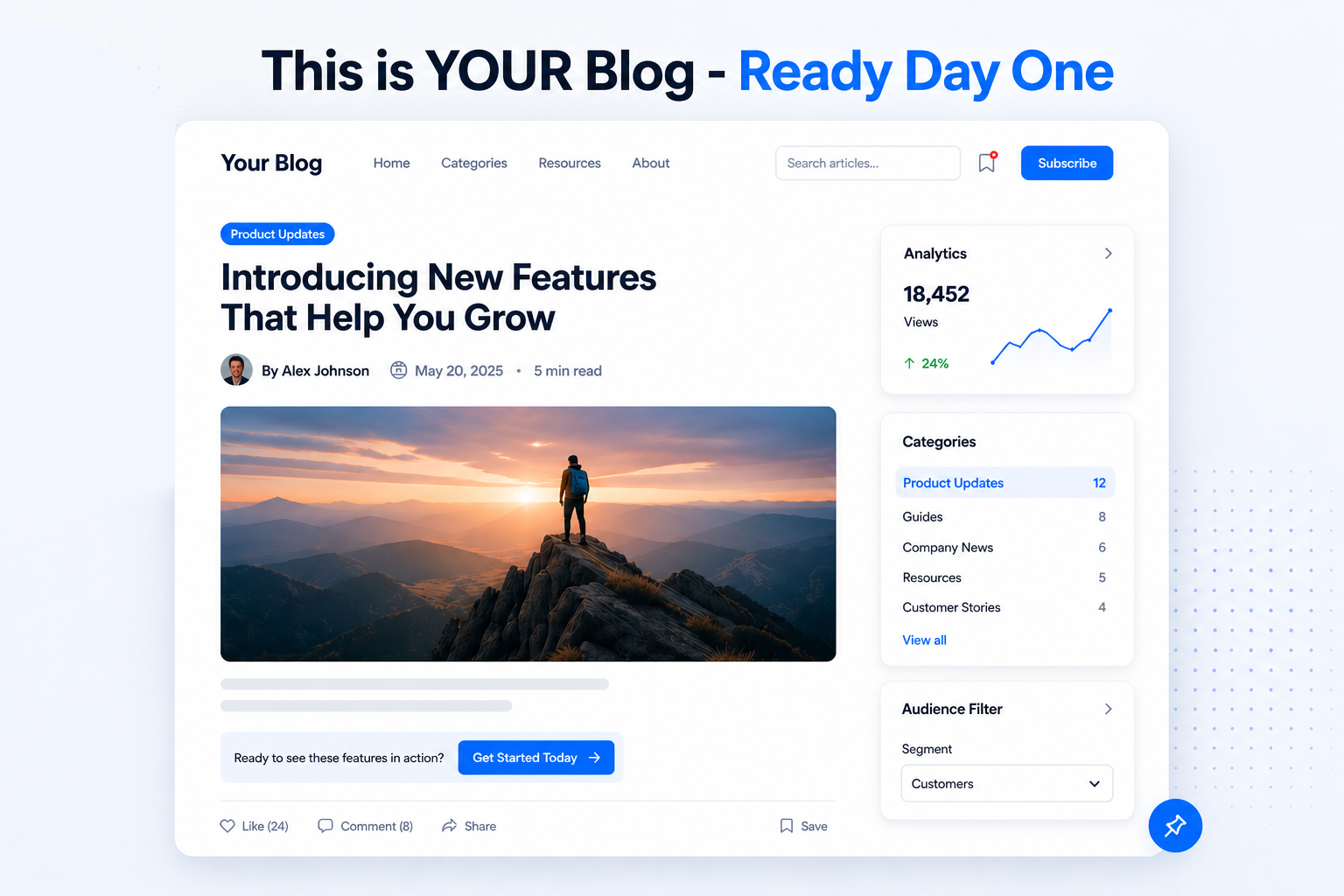
An animated timeline gives visitors a clear sense of momentum. They can see your progress, your announcements, your ideas, and your growth unfold in a way that feels dynamic and intentional.
Filters, categories, tags, search, and “find similar” features make your content easier to explore. A visitor interested in one service, industry, product, or topic can quickly discover related posts without digging through a long archive.
That matters because people rarely arrive on your website with unlimited patience. The easier you make it for them to find relevant information, the more likely they are to stay, learn, trust, and act.
Content That Looks as Good as Your Brand
Your blog should not feel like an afterthought.
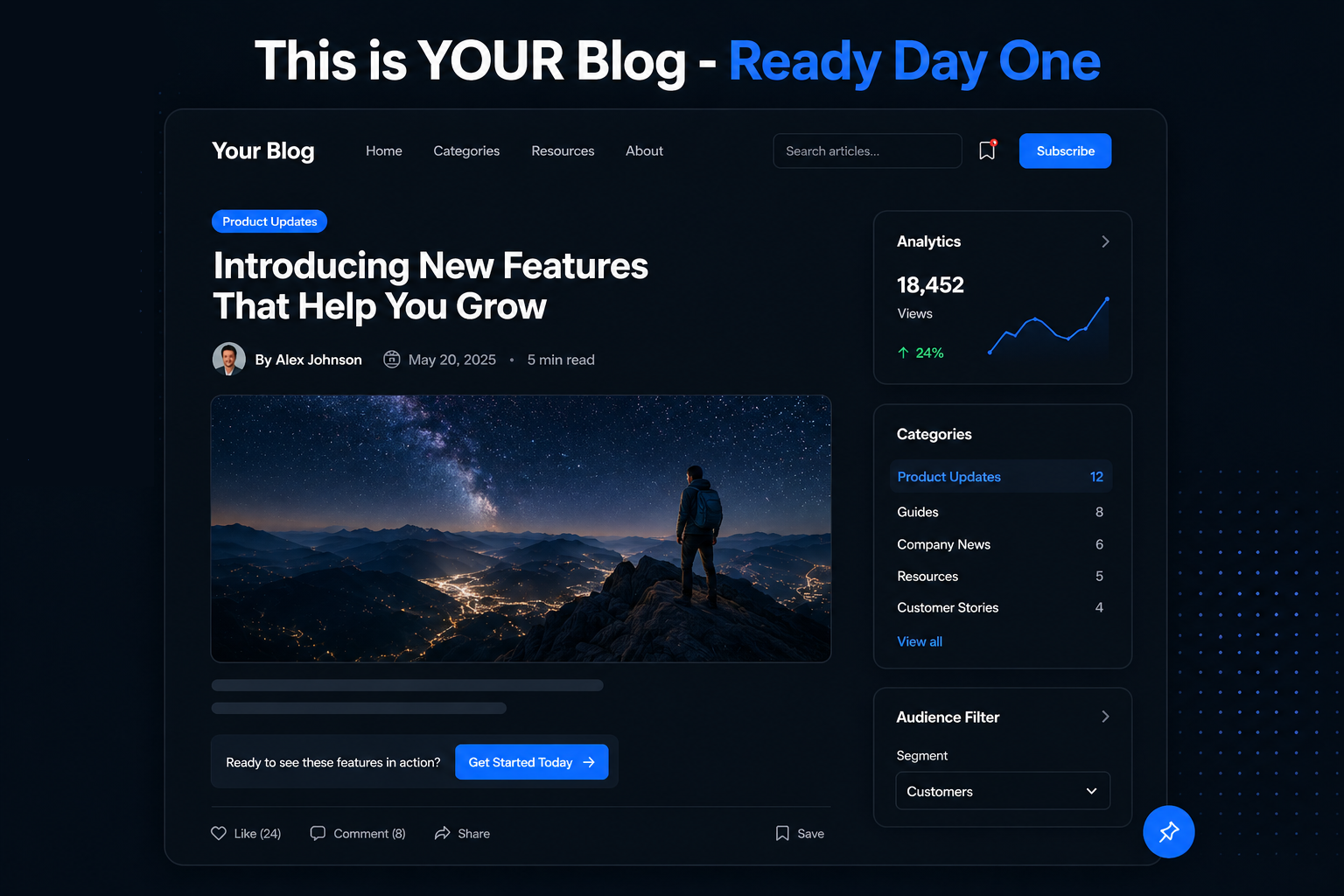
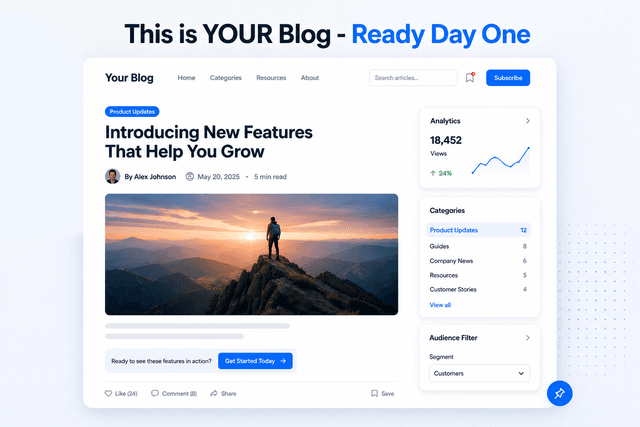
Each post can include a main image, with separate light mode and dark mode variants, so your content stays polished across different viewing experiences. Rich content support allows your team to write posts that feel professional and readable, with quotes, bold text, lists, structured sections, and clear formatting.
You can also feature a main video directly inside a post using the built-in video player. That means your company can publish product demos, founder updates, walkthroughs, training videos, interviews, announcements, and promotional content without forcing visitors to leave your site.
The goal is simple: keep attention where it matters most — on your brand, your message, and your offer.
Section Markers Make Long-Form Content Easier to Navigate
Strong content is not only about what you say. It is also about how easy it is to follow.
Section markers help break longer posts into clear, scannable parts so readers can quickly understand where they are, what comes next, and which parts matter most to them. For businesses publishing service guides, announcements, tutorials, case studies, product updates, or investor-facing news, this makes content feel more organized and professional.
Instead of overwhelming visitors with one long block of information, section markers create natural stopping points. They help readers move through an article with less friction, return to important areas faster, and stay engaged longer.
For your business, that means better readability, better presentation, and more opportunities to guide readers toward the next action — whether that is exploring a service, downloading a resource, watching a video, contacting your team, or subscribing for more updates.
Turn Readers Into Customers
A blog post should not be a dead end.
That is why our blog supports clear calls to action throughout the article. When you mention a service, product, offer, consultation, case study, download, or next step, you can link readers directly to it.
This makes your content measurable and useful.
A post about a new service can guide readers to book it.
A product update can link to the product page.
A case study can send visitors to request a quote.
A how-to article can offer a downloadable guide.
A company announcement can invite people to subscribe, join, or contact you.
This is where the blog becomes more than content. It becomes a conversion path.
Build Community With Likes, Comments, and Moderation
A strong website gives visitors a reason to participate.
With likes, nested comments, and comment moderation, your blog can support real conversations without giving up control. Customers can ask questions. Team members can respond. Readers can engage with each other. Your company can build trust publicly while still keeping the conversation professional and on-brand.
Nested comments make discussions easier to follow. Moderation tools help protect the quality of your site. Likes give quick feedback on what resonates.
This kind of interaction helps your business understand what people care about while making your website feel active and current.
Speak to the Right Audience
Not every post needs to be for everyone.
Audience filters allow your company to shape content for specific groups. You may want certain posts for customers, some for members, some for subscribers, some for investors, and some for the public.
This opens the door to smarter communication.
You can publish broad educational content for everyone, while offering deeper insights, premium resources, or exclusive updates to specific audiences. That gives your business more control over how information is shared and creates natural reasons for visitors to subscribe, join, or become paying members.
Downloads That Create Real Value
File downloads are one of the most practical ways to turn a blog into a business asset.
Your company can offer public downloads, member-only downloads, or subscriber-only downloads. This allows you to share resources strategically.
For example, you might offer:
Pricing guides
Checklists
Catalogs
Brochures
Templates
Whitepapers
Reports
Training materials
Product sheets
Event documents
Demo's and Samples
Client onboarding files
Public downloads can help attract new leads. Member-only downloads can encourage account creation. Subscriber-only downloads can add value to a monthly service or paid community.
Instead of simply giving everything away, your business can decide which resources should be open, which should encourage deeper engagement, and which should reward paying customers.
Built for Teams, Not Just One Person
A growing company often has more than one voice.
With support for multiple authors, your blog can feature insights from founders, managers, team members, specialists, partners, or department leads. This helps your brand feel more complete and credible.
Drafting tools allow content to be prepared before publishing. Pins let you keep important posts visible. Favorites make it easier for users to save content they care about. Categories and tags help organize everything as your library grows.
This gives your team a real publishing workflow, not just a blank text box.
Know What Is Working
Built-in analytics help your company see what people are reading, what they engage with, and what content creates interest. Instead of guessing what matters to your audience, you can make decisions based on behavior.
Which posts get attention?
Which topics lead to clicks?
Which resources are downloaded?
Which updates create discussion?
Which services are being discovered through content?
This turns your blog into a feedback loop. Your audience shows you what they care about, and your business can respond with better content, better offers, and better strategy.
Social Sharing Extends Your Reach
Every post is also a marketing asset outside your website.
With social media sharing built in, readers can help spread your message. Your team can share announcements, insights, promotions, and resources across platforms while linking traffic back to your own website.
This is important because your website should be the center of your digital presence. Social media is useful, but you do not own those platforms. Your website is where your content, brand, calls to action, customer journey, and data can work together.
A strong blog gives your social channels something worth sharing.
A Better Blog Means a Better Business Website
A basic website says, “We are here.”
A strategic website says, “Here is what we do, here is why it matters, here is how we can help, and here is what to do next.”
That difference matters.
Your blog can help your business build trust before a sales call. It can answer objections before a customer reaches out. It can explain your value in detail. It can support your team. It can attract search traffic. It can give existing customers a reason to return. It can showcase your expertise. It can promote your services without feeling pushy.
Most importantly, it gives your business control over its own message.
Ready to Use From Day One
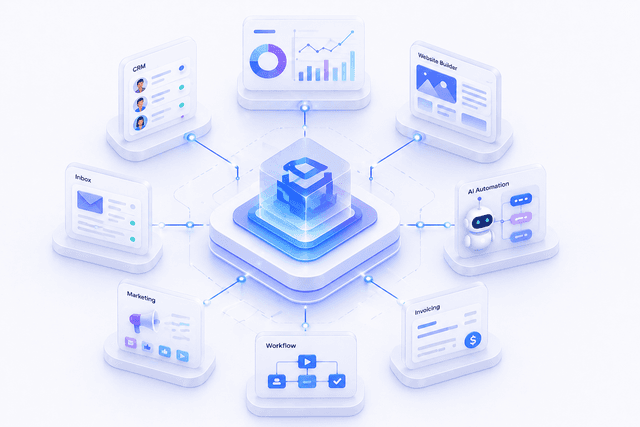
Because this blog system is built directly into our platform, your business does not need to wait on extra development, juggle third-party plugins, or pay separately for every advanced feature.
The tools are already there.
From rich article layouts and video support to audience filters, downloads, comments, moderation, analytics, calls to action, categories, tags, search, favorites, pins, and multi-author publishing, your team can start using a professional content system without turning it into a separate project.
That means less friction, fewer outside tools, and a faster path from idea to published content.
Instead of wondering whether your website can support your next announcement, guide, campaign, resource, or customer update, you can publish with confidence on a platform built to grow with you.
It is not an add-on you have to chase later.
It is part of the foundation.
Your Website Can Be More Than a Website
Small and mid-sized companies often compete with larger brands that have bigger budgets, bigger teams, and more visibility.
But the businesses that communicate clearly, publish consistently, and make their expertise easy to find have a real advantage.
That is what this blog platform is built for.
It gives your company the tools to publish beautifully, organize intelligently, engage meaningfully, promote strategically, and measure what matters.
Your website should not just be something people visit once.
It should be something that helps your business get discovered, earn trust, educate customers, promote offers, support subscribers, and create new opportunities.
Your website can be more than a presence.
It can become an asset.